
Your teachings could reach a wider audience, and your church could grow, if you utilized search engine optimization principles in your social media campaigns.
My name is Chris Jackson, but a lot of people call me the SEO Priest. I’ve helped thousands of churches with their digital marketing, with a particular focus on search engine optimization.

Chris Jackson AKA SEO Priest
And I want to talk about two things that a lot of people think are completely separate from each other: search engine optimization on the one hand and social media marketing on the other.
A lot of people basically treat these as two different realms. SEO is Google, websites, Google Business Profiles, keywords, all that stuff. Social media is Instagram and Facebook and TikTok and YouTube.
But nothing could be further from the case.
Nobody is talking much about search engine optimization for church social media, and I think churches are missing a major opportunity because of it.
So let’s talk about how social media SEO can bless your church, what social media SEO actually is, and then, most importantly, how to do it.
Social Media SEO Is Local SEO
The first and most important way social media SEO can bless your church is by helping people in your local community affiliate with your church.
Social media search engine optimization for churches is really a form of local SEO.
Now, when people hear “local SEO,” usually they think about websites and Google Business Profiles. But local SEO is really about helping all of your online content show up to people who are searching in your local area.
That includes social media.
There are things you can do with your titles, your descriptions, the content within your posts, and your social media profiles that can help your content show up better for people in your local area. That can help you both during the initial algorithmic push of a post and, perhaps even more importantly, in the long tail of search.
SEO Can Give Your Social Media Posts a Much Longer Life
Think about the normal life of a social media post.
Let’s say you publish a short-form video. You get that initial algorithmic push. The platform shows it to a bunch of people and sees what happens.
Obviously, that initial push is important. There are a lot of things you can do to help a video during that stage, and SEO is actually one of them.
Let’s say you’re creating content about Christian principles for marriage. If people have already demonstrated an interest in content about Christian marriage, the social platforms have some idea of who those people are. If your video is clearly about that topic, there’s a higher likelihood that your content is going to get pushed out to those people.
If you also do some local SEO with that content, you have a better chance of connecting with people in your local area.
But where I get really excited is what happens after that initial push.
The Long Tail of Social Media Search
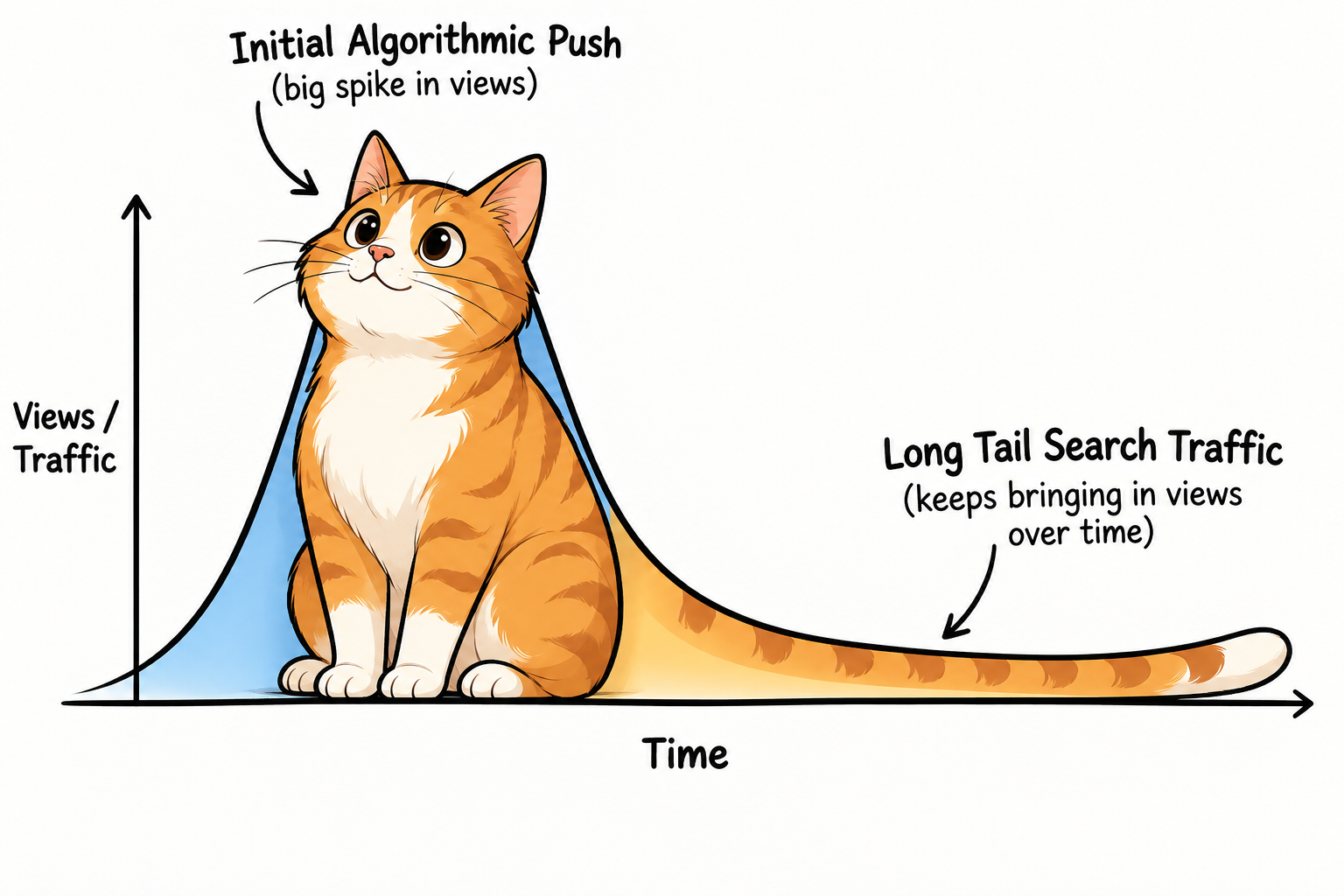
Social media is a search asset in several different ways.
First, Google is indexing social media content, including short-form video. That means your social media content has the opportunity to appear when somebody searches Google for a church in your area or for a topic your church is talking about.
Somebody finds the content. They become interested in what you’re saying. They learn about your church. And eventually—which is what we really want—they might actually affiliate with your church.
But Google isn’t the only search engine that matters.
YouTube, for example, is one of the biggest search engines on the internet. People search YouTube constantly for information on just about every topic imaginable.
And people search Instagram and TikTok too.
A lot of young women especially are using platforms like Instagram and TikTok as search engines. If a young woman wants to find a restaurant in Austin, Texas, there’s a pretty good chance she’s going to TikTok or Instagram and searching for restaurants in Austin rather than going to Google.
I can guarantee you that young women are doing the same thing with churches.
So social media SEO can help you connect with people through Google, which is indexing your social profiles and posts, but it can also help you connect directly with people who are using social platforms themselves as search engines.
A Real Example From My Own YouTube Channel
One of my better-performing recent videos is a short called something like Age Gaps in Dating and Marriage: Okay With God? What the Bible Says About Age Gap Relationships.
At the time I looked at the analytics, it had 815 views.
Admittedly, that isn’t huge. But for a smaller channel like mine, that’s actually pretty decent traffic.
What’s much more interesting is how it got those views.
The initial algorithmic push gave me around 480 views within the first couple of days. Then the video basically settled into a little trickle of visibility.
But during that trickle, YouTube was continuing to test the video against other videos and searches.
Then, roughly 175 days into the life of the video, it really started to take off again.
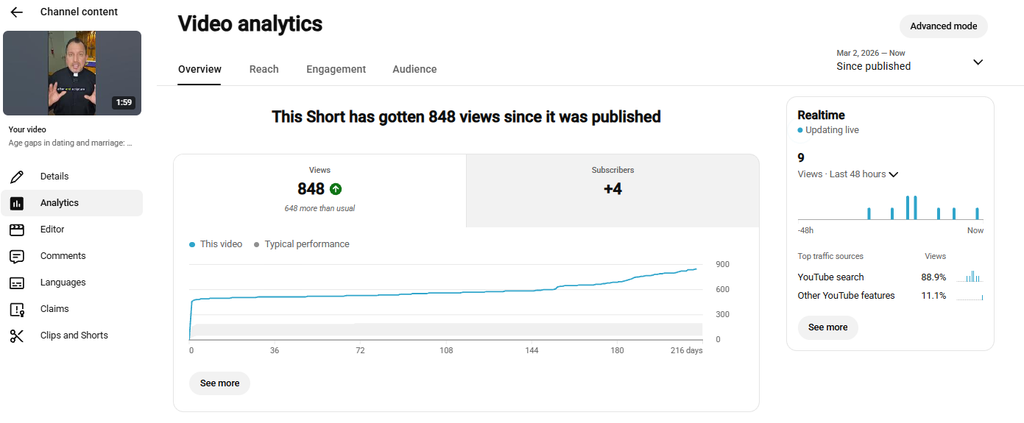
Now it might get five or ten views a day.
Five or ten views doesn’t sound exciting. But think about five or ten views a day over months or even years.
Suddenly that video can accumulate far more traffic through long-term search than it ever received during its initial algorithmic push.
And I get it. The initial algorithmic push is exciting. It’s exciting when a video gets 1,500 views or 2,000 views right away.
But what I’m aiming for is not having to reduplicate my effort all the time.
I want work that I did once to continue paying off in the long term.
That’s why I optimize so much of my video content for search.
Make More Out of What Your Church Is Already Doing
Another reason churches should care about social media SEO is that it lets you make better use of resources you already have.
Your church might have a social media manager or communications person.
And I’m gonna be honest: most church social media managers and communications managers really don’t like SEO.
I’ve seen it. I’ve had the conversations with them.
Their eyes start rolling into the back of their heads as soon as you start talking about Google Business Profiles and meta tags on church websites.
But they like social media.
They like Instagram. They like TikTok. They like making videos.
Great.
Social media SEO is a way to get some SEO exposure through work those people are already doing.
The same goes for your content. There’s a pretty good chance your church is already publishing sermons online. Maybe you’re already cutting those sermons into little snippets for shorts.
Search engine optimization can help you make more out of what you’re already doing.
Want to Work on Your Church’s SEO One Week at a Time?
By the way, if all of this SEO stuff sounds useful but also like one more thing you have to figure out, I have a 52-week newsletter called the Church SEO Shape Up.
Every week, I give you one easy SEO workout for your church. (Check out the workout on Social Media SEO!) Nothing overwhelming. Just one thing to work on that week. Follow along for a year, and you’re going to have a church that is showing up a whole lot better in local search than it was when you started.
You can sign up at churchseo.io/newsletter/.
All right, back to social media SEO.
What Is Social Media SEO, Anyway?
All search engine optimization is really about one thing:
Helping your content show up where people are searching.
That’s it.
Maybe they’re searching on Google. Maybe they’re searching with AI tools like ChatGPT, Perplexity, or Claude. Maybe they’re searching on TikTok, Instagram, or YouTube.
SEO is about helping you show up wherever people are searching.
And I think search engine optimization can almost always be boiled down to two basic factors:
- Properly formatted content.
- External validation.
That’s true for your website. It’s true for your Google Business Profile. And it’s true for your social media.
Exactly what “properly formatted content” and “external validation” look like is going to change from platform to platform.
But those two basic principles remain.
So let’s talk about how to do it.
Start With Your Social Media Profiles
The first thing you need to pay attention to is your profiles.
There are a few things I want on every church social media profile.
First, fill the entire thing out.
Don’t leave fields empty. Fill them up. Every last one.
And while you’re filling everything out, make two things very obvious:
You are a church.
And:
You serve a particular community.
That first one might sound stupidly obvious, but apparently it isn’t.
There are a lot of churches that don’t like using the word church. This seems especially common among big churches, non-denominational churches, and churches that want to look non-denominational even when they aren’t.
So they’ll use something like ministries or worship center instead.
Guess what?
Nobody searches for worship centers.
Nobody searches for “ministries near me.”
People search for churches.
Even people who want to attend the kind of church that doesn’t make a big deal about being a church are still going to use the word church when they search for one.
So use the word church.
Don’t get smart about it.
Don’t let your branding get in the way of people who are looking specifically for you.
Use the word church in your name. Use the word church in your description.
Tell Search Engines Where Your Church Actually Is
You should also make the community you serve obvious.
Don’t just call your profile:
Grace Baptist Church
Call it something like:
Grace Baptist Church of St. Louis
Or:
Grace Baptist Church – St. Louis
And put that information in your description too.
I’d go further than that.
Put your street address in your profile description.
Put your phone number in there.
That helps all these different technologies understand that the entity represented by your website is the same entity represented by your Facebook profile, which is the same entity represented by your Instagram account, which is the same actual church sitting at a physical address in your community.
Name. Address. Phone number.
Put them in the descriptions of your profiles.
Put Local Information in Your Social Posts Too
I would also start putting this information into individual social media posts, especially video posts.
If you’re writing a short text post on X, obviously dumping your church’s entire address and phone number into it might look a little weird.
But with a YouTube Short, Instagram Reel, Facebook Reel, or TikTok video, you have a description that isn’t necessarily sitting right in front of the viewer.
Use it.
Let’s say your pastor records a short video about Christian parenting.
At the bottom of the description, you could put:
“Pastor Mike Smith serves Grace Baptist Church of St. Louis.”
Then put the church’s name, address, and phone number.
You never know what’s going to happen from that.
Somebody might actually show up at your church because they saw your address in that post.
Somebody might call you and ask for counseling about their marriage or their relationship with their kids because they saw the phone number.
Maybe.
But something I can pretty well guarantee is that you’re giving Google and the social platforms additional confidence that you are a real church serving a real community.
You’re helping the machines understand how everything fits together.
Talk About Things People Actually Search For
The next step is making content about topics people are actually searching for.
And then you need to use the words people are searching for.
I try to do this in three places:
The title. The description. And the first few words of the video.
Go back to my age-gap video.
I optimized that video around the question:
What does the Bible say about age gap relationships?
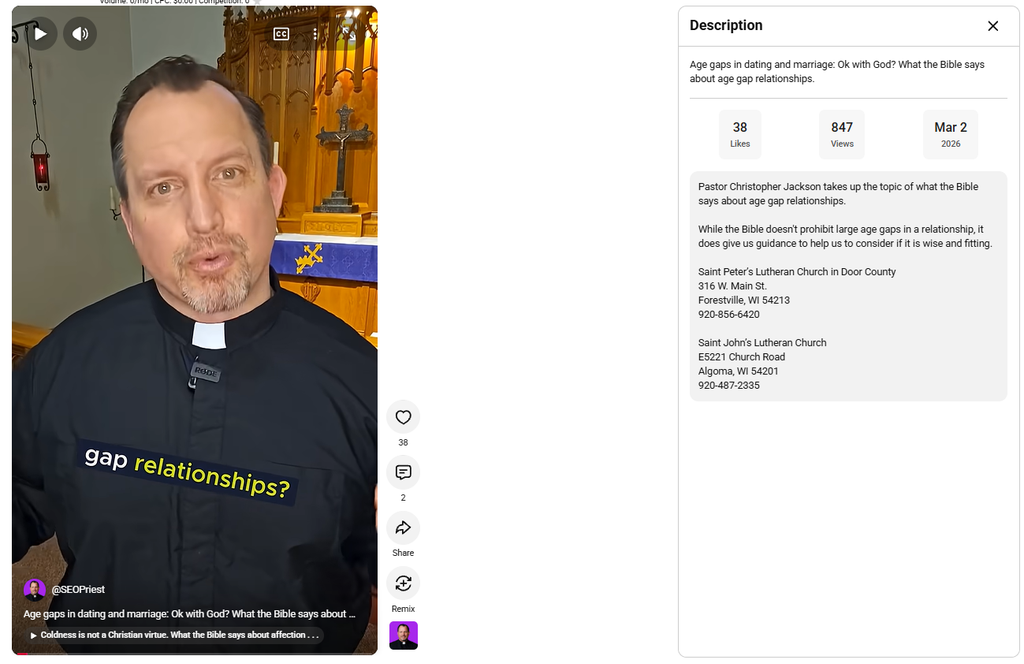
So what do you see right at the beginning?
Age gaps.
Then I’ve got “What does the Bible say about age gap relationships?” in the title.
Then I’ve got it in the description.
And then I say it in the video itself, very early:
“Pastor, what does the Bible say about age gap relationships?”
Now YouTube has all kinds of signals telling it exactly what this video is about.
But this isn’t just for YouTube.
When a person searches “What does the Bible say about age gap relationships?” and clicks my video, they immediately hear me say essentially the exact question they just searched for.
They know they landed in the right spot.
So they’re more likely to stick around and watch.
That’s SEO connecting you with an actual searcher.
And here’s the funny thing:
Have I ever in my life woken up and said, “You know what I really want to talk about today? What the Bible says about age gap relationships”?
Absolutely not.
I wouldn’t even have known that this was a topic people were concerned about.
But the plain fact of the matter is that people are concerned about it.
So I created content to answer the question.
That’s what good SEO does.
Don’t Forget External Validation
So far we’ve mostly talked about properly formatting the content.
But remember the other half of SEO: external validation.
There are lots of forms of external validation on social media.
The obvious one is followers.
Follower counts don’t mean as much as they once did, but they still mean something. So recruit followers. Reach out to your friends, family, church members, and other people in your community.
Just be forward about it.
Ask them to follow your church.
Probably more important than raw follower counts, though, is actual engagement.
When you make a new post, it would be great if you had a group of people who were willing to step up and leave a comment.
It doesn’t necessarily take hundreds of comments.
Even a relatively small amount of activity can start signaling to the algorithms that people are interested in this content.
Comments seem to be particularly important right now.
And that isn’t just useful for the social platform. Google can see engagement around social content too. That’s another signal that this is something worth showing to people.
Embed Your Social Content on Your Website
Another form of external validation is embeds.
Let’s say your pastor makes a useful video answering a question about Christian parenting.
You could publish a post on your church website containing the transcript of that video and then embed the original video right into the page.
Now you’ve connected the social media asset with your website.
You’re giving search engines additional context around that content, and you’re potentially helping the social post itself continue to get traffic.
You can also build links to important social content.
If another website or blog links directly to one of your social posts, that’s another form of external validation. Especially on the Google side of things, those links can make it more likely that Google sees the content as something worth including in search results.
Here’s the Stupidly Simple SEO Trick for Finding Topics
So how do you actually know what people want your church to talk about?
Here’s a time-tested SEO trick:
Autocomplete.
Go to Google or YouTube and start typing a question.
For example:
Can a Christian…
And then stop typing.
Look at what Google or YouTube suggests.

Those suggestions aren’t random. They’re topics people search for.
You can do this with all kinds of prompts, like:
- Can a Christian . . . .
- What do Baptists/Lutherans/Catholics/Presbyterians believe about . . . .
- What does the Bible say about . . . .
Suddenly you have a massive list of actual questions that actual people are asking about the Bible, Christianity, marriage, parenting, addiction, relationships, money, sex, death, suffering, and just about anything else imaginable.
You don’t have to sit around in a church communications meeting trying to invent topics you think people might be interested in.
They are literally telling you what they’re interested in.
Answer their questions.
Stop Thinking of Social Media as Disposable
I think this is ultimately the biggest shift churches need to make.
Social media doesn’t have to be disposable.
You don’t have to publish something on Tuesday, get 600 views, watch it disappear by Thursday, and then start all over again.
Some of your content can keep working for you.
A video answering a real question people are searching for can continue accumulating views months or even years after you made it.
A locally optimized video can introduce somebody to your church long after you’ve forgotten that you posted it.
And that’s what I’m after.
I don’t want to constantly reduplicate my effort.
I want the work I do today to continue paying off six months from now.
That’s what search engine optimization can bring to your church’s social media strategy.
And ultimately, the point isn’t algorithms or views or traffic for their own sake. It’s helping the teachings of your church reach people who are actually looking for them—and helping people in your community find and affiliate with your church.